A hybrid space for climate lab and architecture studio


In the very heart of Leuven, Belgium, just off the busy Diestsestraat shopping street, the architect firm Archipelago has transformed a neglected inner block into its new headquarters – part of a mixed office and residential project combining living, shopping and working around a green courtyard. Where there used to be almost fully paved surfaces and 67 garage boxes, the site now opens up to a lush inner garden with trees, planting and shared outdoor spaces. The courtyard is designed as the cool green heart of the block, reducing urban heat stress and creating a more pleasant microclimate for both building users and neighbours. Underneath, a multi-storey car park is carefully topped with a substrate layer that can support medium-sized trees. The site is designed to be water neutral: rainwater in the courtyard is retained, reused or allowed to infiltrate back into the soil via infiltration shafts.
Visit a reference projectSolution
Solar Shading , Hybrid Ventilation
Location
Leuven, Belgium
Sector
Commercial Buildings
Project Type
Refurbishment
Project partners
archipelagoFrom closed backland to open laboratory
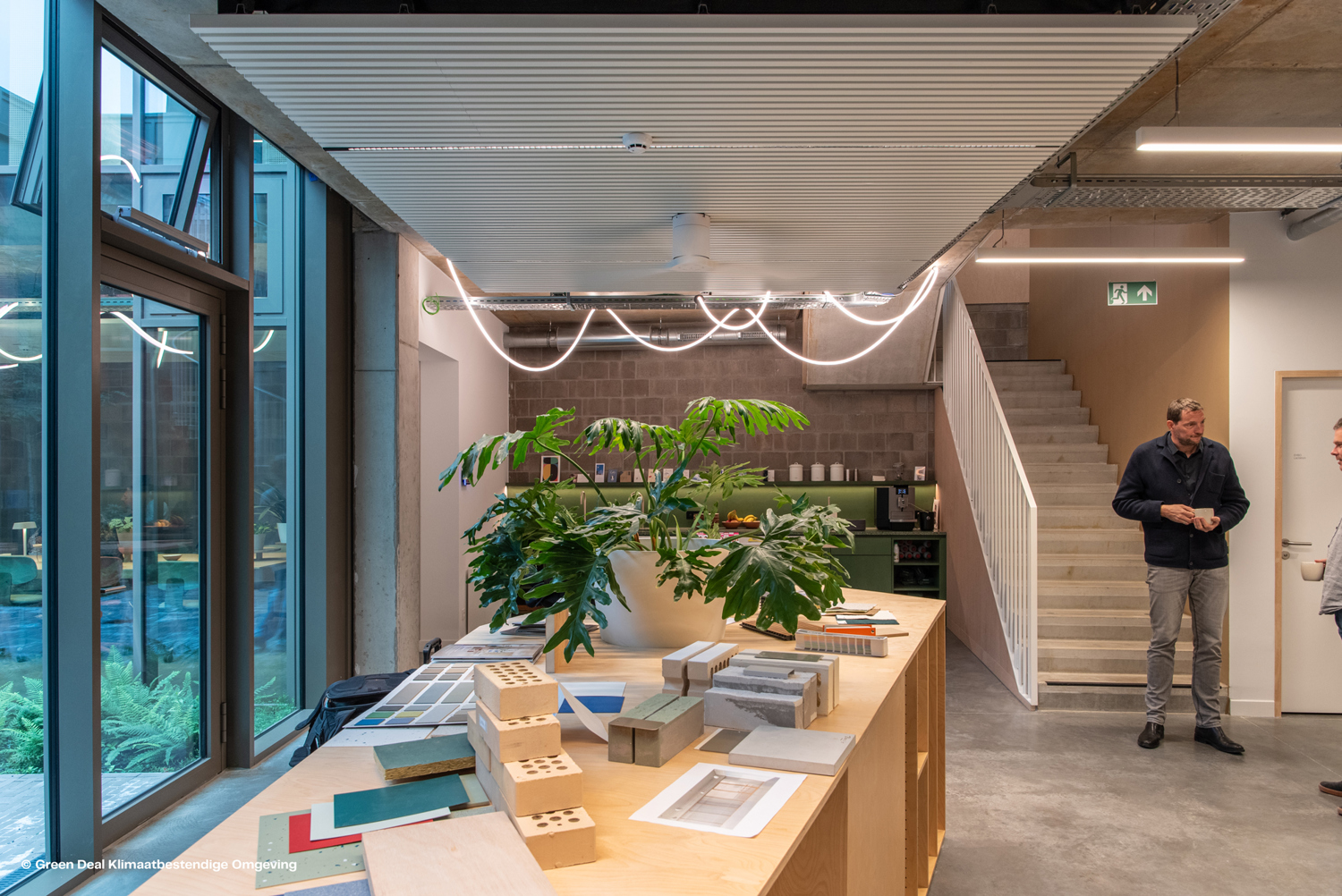
The new Archipelago office sits slightly set back from the street, looking onto this courtyard and connecting it visually with the urban bustle of Diestsestraat. The building itself is compact, partly “nested” within the surrounding blocks and focused on north-west oriented glazing and a strategically placed patio, so it can welcome generous daylight while limiting unwanted solar gains. At night, the exposed thermal mass works together with automated openings to cool the building like a “thermal sponge”.


Climate-resilient, low-tech and high comfort
For its own headquarters, Archipelago wanted more than a standard office. The building was conceived as a climate-resilient “laboratory” for future workplaces:
- Minimal technical installations, maximum value from the building fabric
- Comfortable in today’s climate and robust in hotter future scenarios
- An open, transparent workspace that connects city and garden
Together with research from KU Leuven, the design team explored how far passive cooling strategies – thermal mass, night flushing and smart façades – can reduce the need for active cooling. Simulations show that the concept can cut cooling energy demand by roughly two-thirds in current weather conditions and still halve it in future warmer weather conditions compared to conventional offices.
To make this low-tech concept work in practice, Archipelago would benefit from a highly responsive indoor climate control system that could:
- Orchestrate natural and mechanical ventilation in a hybrid strategy
- Work closely with cooling/heating ceilings and limited active systems
- Protect comfort in a dense, creative office with varying occupancy
- Keep the user experience simple for both designers and facility managers
WindowMaster’s NV Embedded® solution was selected as the control “brain” for this experiment in climate-resilient office design.
The building need – and how NV Embedded® meets it
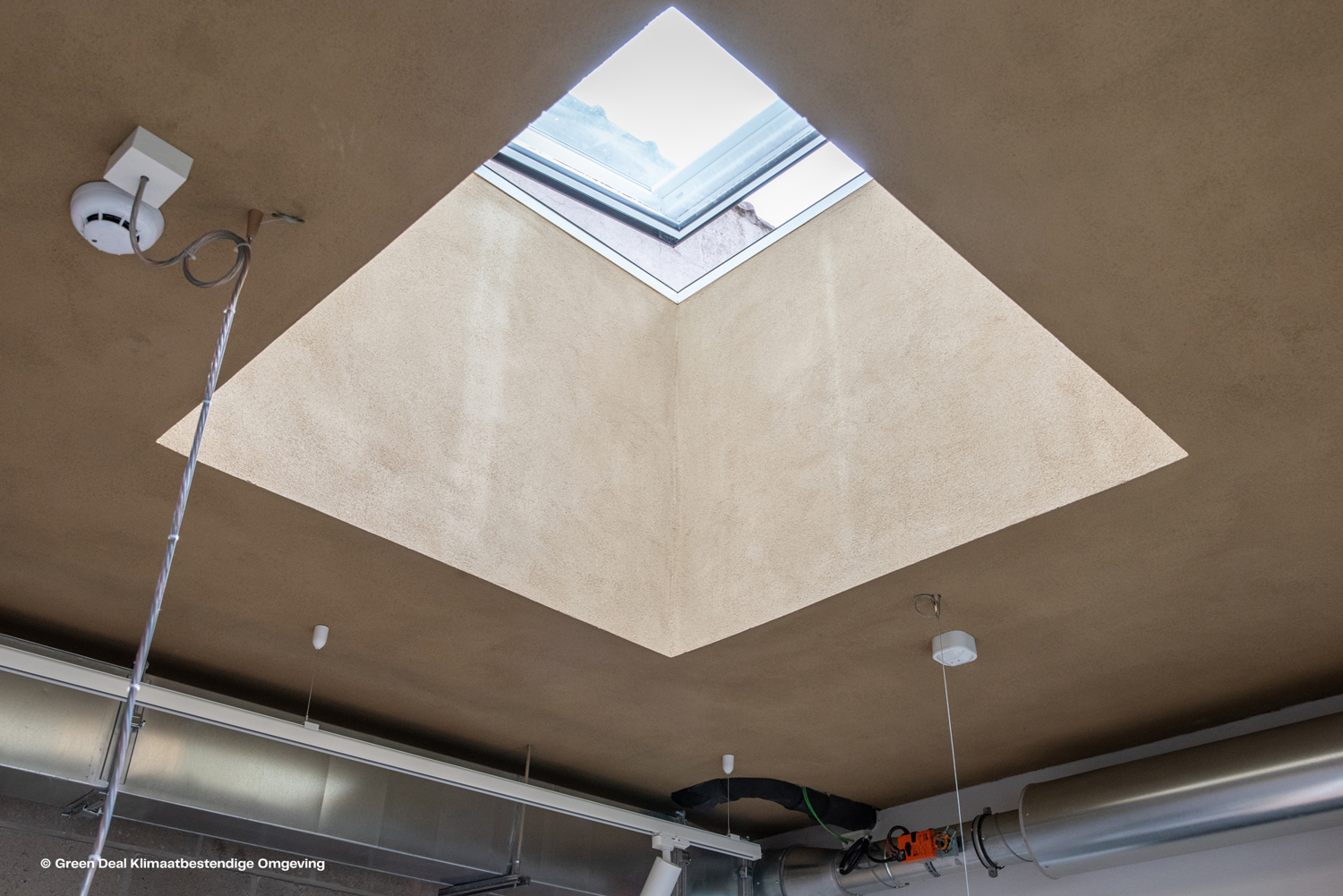
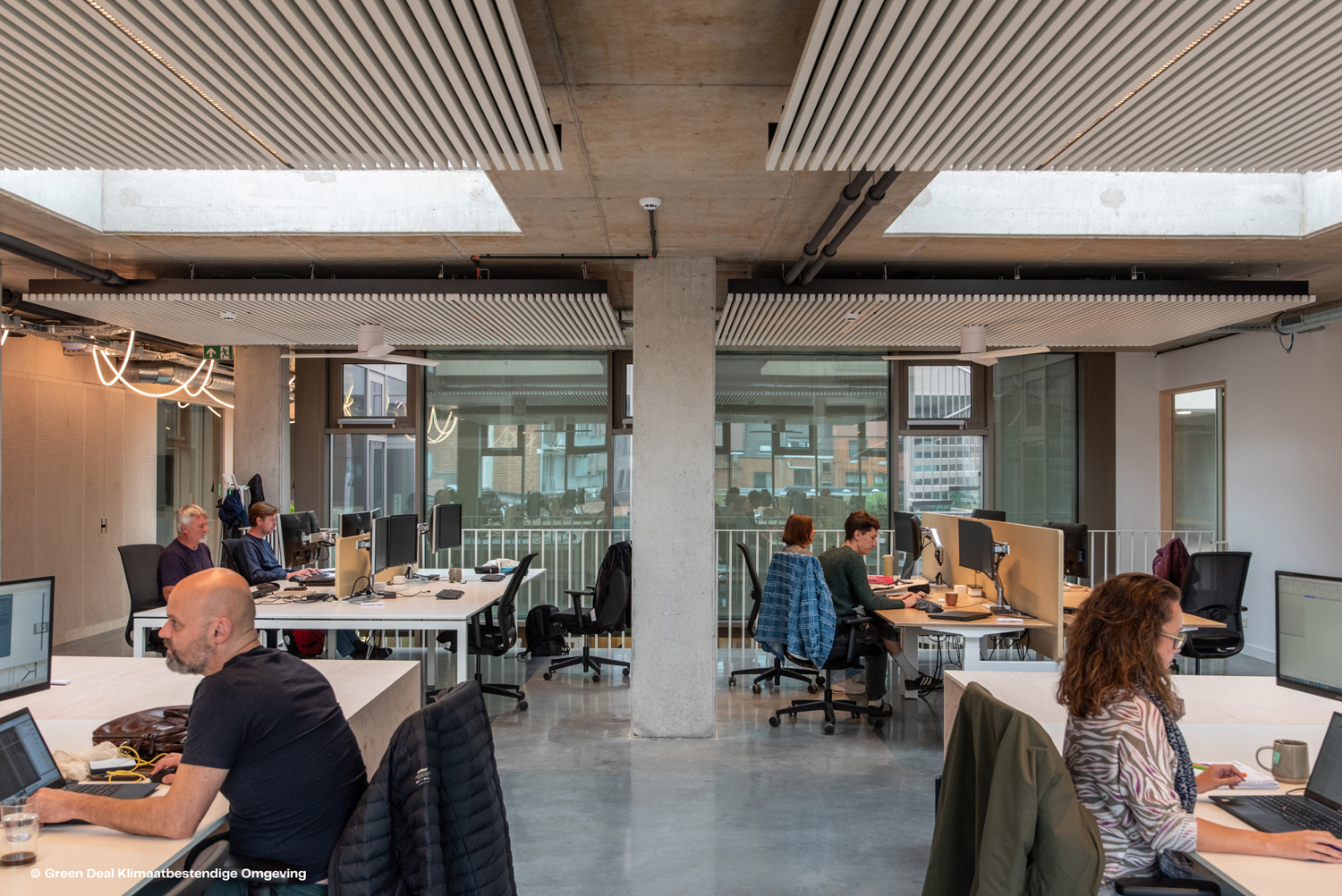
The new HQ is spread across two main levels with a central patio and openings in the north façade, the courtyard façade and the roof. To fully exploit this geometry, Archipelago chose a hybrid ventilation strategy that mixes: • Single-sided natural ventilation in smaller rooms and offices • Stack-driven natural ventilation using the height differences between façade and roof openings • Mechanical air supply and extract via VAV dampers where required Working as an integrated indoor climate system, WindowMaster’s NV Embedded® controls: • Automated facade and roof windows • External solar shading • Heating and cooling valves for the radiant ceilings • VAV dampers for mechanical ventilation The building is divided into 16 independently controlled zones, covering open landscapes, collaboration spaces, silent rooms, reception and support areas. Each zone is equipped with WindowMaster room sensors that continuously monitor temperature and CO2 levels, while a dedicated weather station provides live data on outdoor temperature, wind and rain. Motorised windows are driven by compact WMU 831 chain actuators and coordinated by networked WCC 320 Plus MotorControllers with embedded NV Embedded® functionality. Local wall switches in each zone allow occupants to override the automatic control for short periods when needed. The whole system is integrated with the building management system (BMS) via BACnet IP and is prepared for secure cloud connectivity for data and remote services.

A hybrid strategy based on the building’s behaviour
The control concept is deliberately simple from the user’s perspective, but sophisticated behind the scenes. The building can run in three main states – Occupied, Unoccupied and Secured – with NV Embedded® automatically shifting between summer and winter modes depending on indoor comfort temperature and outdoor conditions.
Key comfort parameters include:
- Comfort room temperature setpoint around 22°C
- CO2 thresholds adjusted by season
- Intelligent limits to prevent over-cooling when outdoor temperatures drop
In summer mode, the system prioritises:
- Using natural ventilation whenever outdoor temperature is above a configured threshold and indoor temperatures start to rise
- Combining CO2-driven window openings with night flush of the exposed thermal mass, so the building can start the day cool without relying on active cooling.
In winter mode, the priority shifts to maintaining thermal comfort while controlling indoor air quality. Windows then operate in short, CO2-driven “pulse” openings, with the opening degree limited by wind speed and outdoor temperature.
Weather-safe operation – rain or sun
The weather station continuously monitors wind and rain. When wind speeds exceed the threshold limit or heavy rain is detected, NV Embedded® automatically reduces or closes openings. Meanwhile, specific “safe” opening positions are programmed for rain. This ensures that the building can confidently use natural ventilation without compromising the interior. Because the HQ is designed with minimal active systems, the performance of solar shading and cooling/heating ceilings is critical. NV Embedded® coordinates these elements with the ventilation strategy: • Solar shading is deployed to reduce overheating risk while keeping glare and daylight levels comfortable • Passive measures and natural ventilation cover most of the cooling needs, while cooling ceilings provide the extra cooling when required • Mechanical ventilation ramps up or down depending on natural airflows and indoor quality The result is a genuinely hybrid system where natural and mechanical measures are orchestrated as one coherent strategy instead of competing sub-systems.

Comfort, control and a calmer indoor climate
For the architects and engineers working in the building, the ventilation strategy is largely invisible – and that is the point. The NV Embedded® solution is designed to quietly deliver:
Fresh air where it’s needed
Room sensors in each zone ensure that spaces with higher occupancy or internal loads receive more ventilation, while quieter areas are not over-ventilated.
Stable, comfortable temperatures
By using the building’s thermal mass, night cooling and careful solar control, indoor temperatures remain within a comfortable band through normal summer conditions, with significantly less active cooling required than in a typical office.
Low noise levels
Natural airflows through window openings and patio/roof vents are almost silent compared to purely mechanical systems, supporting focused work and concentration.
A sense of personal control
Simple wall switches allow occupants to override the automated setting for a short period – opening or closing windows locally without disturbing the overall strategy. After the override expires, the system gently takes over again.
For the facility team, integration with the BMS and secure cloud connectivity means the installation can be monitored, fine-tuned and analysed over time. This aligns with Archipelago’s ambition to use the HQ as a living laboratory for future projects: they can see in real time how a low-tech, data-driven climate strategy behaves in a changing climate.
A future-proof office – and a reference for the city
The Archipelago headquarters in Leuven shows how thoughtful architecture and intelligent control can turn a once-problematic inner block into a climate-resilient, comfortable place to work – with fresh air, daylight and a shared green courtyard at its core. As part of the Flemish Green Deal for climate-resilient environments, the project now serves as an example for other inner-city office developments grappling with heat stress, water management and energy use. The NV Embedded® solution ties the concept together, enabling hybrid ventilation, shading, and radiant systems to act as one coherent strategy that supports both the building’s performance and the wellbeing of its users.

“Archipelago wanted their Leuven office to prove that you can achieve high comfort with fewer, smarter systems. By combining passive design with our NV Embedded® control, the building now utilises natural forces and only falls back on active systems when really needed. It’s a powerful example of how fresh air, data and design can work together in a city that is steadily getting warmer.”

Jannick Roth
Building Performance & Standardization Manager, WindowMaster