Single-side ventilation – A smarter design for healthier indoor environments

In modern building design, single-side ventilation is gaining attention as a practical solution for improving indoor environments while reducing reliance on mechanical systems. Unlike cross ventilation, which requires openings on opposite sides of a building, single-side ventilation achieves airflow through windows or vents located on just one façade. This makes it particularly relevant in urban areas and taller buildings, where design constraints often limit options. By relying on natural forces such as wind pressure and temperature differences, single-side ventilation introduces fresh outdoor air and removes stale indoor air, improving comfort and air quality without excessive energy use. Combined with automated systems and intelligent controls, it becomes part of an energy-efficient ventilation strategy that supports both healthier and safer indoor environments. This article explores how single-side ventilation works, its benefits and limitations, current trends, and how we at WindowMaster develop solutions that combine natural airflow with smart technology.
What is single-side ventilation and how does it work?
Single-side ventilation is a type of natural ventilation that enables airflow using only one facade of a building. Air enters and exits through the same opening—such as a window or vent—driven by wind pressure, temperature differences, and small-scale turbulence known as eddy penetration. This creates a fluctuating or pulsating flow that exchanges indoor and outdoor air. Unlike cross ventilation, which relies on openings on opposite sides to generate a steady flow rate, single-side ventilation works even where design constraints allow only one accessible side. It can be achieved through a single opening or by using upstream and downstream openings at different heights in the same façade, which enhances air movement by taking advantage of pressure differences. In essence, single-side ventilation makes it possible to introduce fresh air and remove stale air in spaces where cross or stack ventilation cannot be applied, offering a flexible and cost-effective strategy in many modern buildings.
Natural ventilation strategies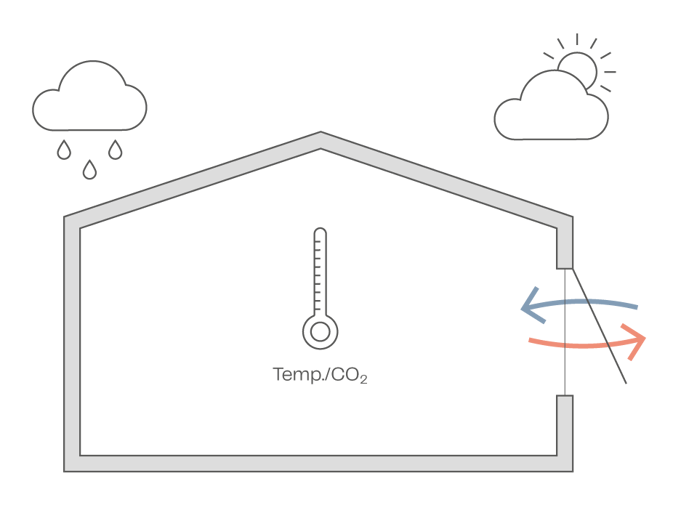
Why single-side ventilation matters today
The demand for single-side ventilation is growing as buildings become more airtight and urban environments more constrained. In many projects, especially taller buildings or urban sites with limited façades, cross ventilation or large stack ventilation shafts are not feasible. Here, single-side strategies ensure a steady flow of fresh outdoor air and removal of stale indoor air. With increasing focus on indoor environment quality, ventilation must not only meet minimum standards but also enhance occupant thermal comfort and productivity. Single-side ventilation offers a cost-effective and practical alternative to fully mechanical ventilation systems, reducing energy consumption while supporting healthier building design. By leveraging natural forces—from subtle temperature differences to varying wind pressure—this approach supports healthier, more resilient buildings. When paired with intelligent control solutions, it becomes a reliable part of modern ventilation in buildings, ensuring both comfort and compliance.

How WindowMaster enhances single-side ventilation
At WindowMaster, we help transform single-side ventilation from a basic design principle into an intelligent and reliable part of modern building strategies. By integrating our window actuators, control panels, and advanced natural ventilation systems, airflow can be managed dynamically – responding to wind pressure, temperature differences, and indoor air quality in real time.
For projects where a single facade is the only option, our solutions ensure that ventilation does not rely on chance. Automated openings can be programmed to adjust at different heights, enhancing the natural movement of air and improving ventilation effectiveness even in deeper rooms. When conditions change, our systems can seamlessly switch to mixed mode ventilation, where mechanical ventilation systems support airflow to maintain comfort and compliance. By combining natural forces with intelligent technology, WindowMaster enables buildings to achieve optimised indoor climates and reduced energy use. Whether in offices, schools, or residential projects, our expertise ensures that single-side ventilation is not just possible but optimised.
The science and limitations of single-side ventilation
The effectiveness of single-side ventilation depends on the physics of airflow. When wind velocity passes across a building façade, it creates small pressure differences at window openings. Combined with temperature differences between indoor and outdoor air, this can generate a pulsating flow that refreshes the occupied space. Even slight turbulence, known as eddy penetration, helps mix outdoor air with the air inside. However, this method has natural limitations. Compared to cross ventilation, the ventilation rate achieved through a single facade is typically lower. Factors such as ceiling height, room depth, and window size can greatly influence effectiveness. In deeper rooms, air distribution may be uneven, leaving pockets of stale air. Because of these constraints, single-side ventilation is often best when combined with mixed mode ventilation, where natural forces are supported by mechanical devices. This ensures more stable airflow and helps maintain consistent air quality, even under varying weather conditions or in sheltered sides of buildings.

What new trends are shaping the future of single-side ventilation?
Single-side ventilation is no longer seen as a purely passive solution but increasingly as part of intelligent building strategies. A clear trend is the combination of natural and mechanical ventilation, where automated systems support airflow when wind pressure or temperature differences are insufficient. This creates more reliable ventilation rates while still keeping energy use low.
Smarter control and facade integration
Another innovation is the integration of digital control systems and sensors. Automated open windows can react in real time to changes in wind speed, air pressure, or indoor air quality, ensuring that ventilation effectiveness is maintained throughout the day. This is especially valuable in urban environments, where conditions can shift quickly.
Architects and engineers are also paying more attention to aesthetics and practicality. Modern facades incorporate discreet openings, ensuring that ventilation does not compromise design intent. With growing emphasis on energy efficiency and thermal comfort, single-side ventilation is becoming an essential part of new-build or refurbished projects across offices, schools, and residential developments.
Discover a smarter building design with single-side ventilation
Single-side ventilation offers a practical and cost-effective way to improve indoor comfort, maintain healthy air quality, and reduce energy use—even where building layouts or façades limit other ventilation options. When supported by intelligent automation, it becomes more than a passive principle: it transforms into a dependable part of a modern ventilation strategy. At WindowMaster, we design solutions that combine natural forces with smart technology to deliver flexible, future-ready results. Contact us today to learn how our experts can help you achieve healthier, more efficient buildings with single-side ventilation.
Contact us today